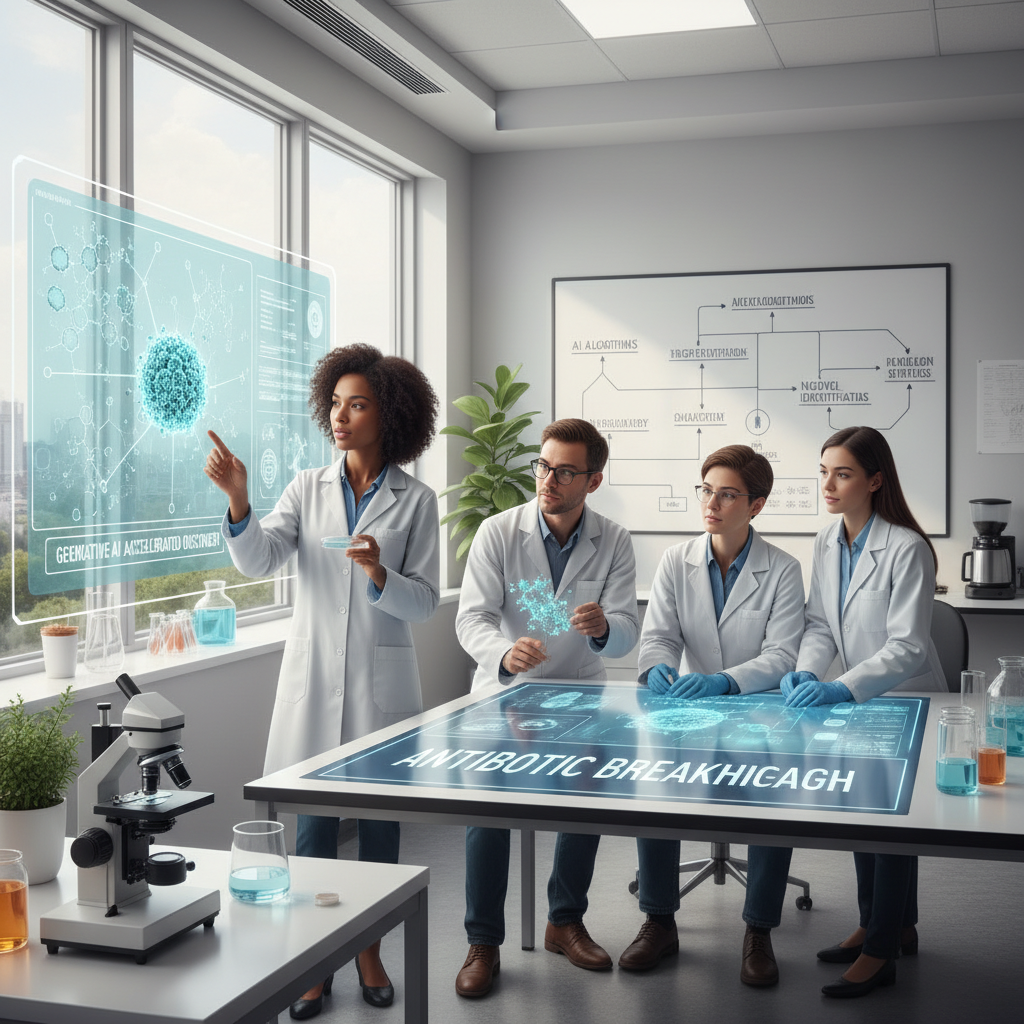
For decades, the pharmaceutical pipeline for new antibiotics has remained precariously stagnant, even as drug-resistant “superbugs” claim more than a million lives annually. This week, however, a team of researchers announced a pivotal advancement: the discovery of a new class of antibiotics specifically designed to combat methicillin-resistant *Staphylococcus aureus* (MRSA). The breakthrough was achieved not through traditional laboratory trial-and-error, but through the application of generative deep-learning models, marking a fundamental shift in the landscape of molecular discovery.
The study, published in a leading peer-reviewed journal, details how a consortium of biotechnologists and data scientists trained neural networks on vast datasets of chemical structures and their biological effects. While conventional methods of drug discovery can take a decade and cost billions of dollars, the AI model scanned more than 12 million compounds in a matter of weeks. By predicting which molecular structures would be toxic to bacteria but safe for human cells, the technology effectively bypassed the most expensive and time-consuming bottlenecks in the developmental cycle.
Dr. Aris Persidis, an industry expert in computational biology, noted that the speed and precision of the discovery are “unprecedented.” The model was able to identify chemical motifs that had never been documented in existing medical literature, suggesting that AI can explore a “chemical space” far beyond the reach of human intuition. This capability is viewed by many in the scientific community as a necessary weapon in the escalating evolutionary arms race against bacterial resistance.
Despite the enthusiasm, significant hurdles remain before the treatment reaches hospital wards. The newly identified compounds must now undergo rigorous multi-phase human clinical trials to ensure long-term efficacy and safety. Furthermore, regulatory bodies, including the FDA, are currently navigating the complexities of evaluating drugs derived from machine-learning algorithms. The “black box” nature of some AI processes—where the machine arrives at a result without a transparent chain of human logic—presents a unique challenge for traditional validation protocols.
Nevertheless, the achievement signals the dawn of a new era in biotechnology. As generative AI evolves from a high-tech novelty into a foundational tool for drug synthesis, the boundary between digital innovation and biological application continues to blur. For a global healthcare system under constant threat from evolving pathogens, this computational leap forward offers a rare and vital sense of optimism.