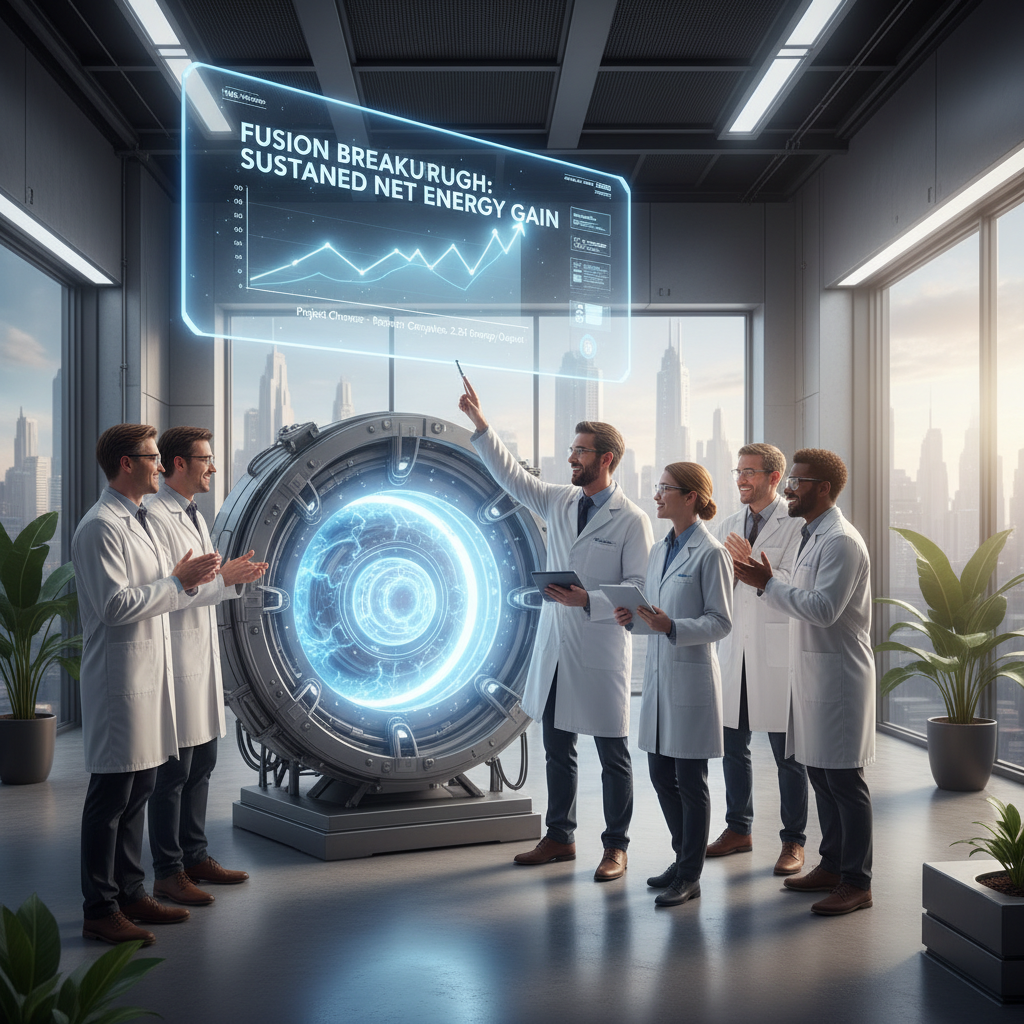
In a laboratory facility on the outskirts of southern France, an international consortium of physicists has announced a significant leap forward in the quest for near-infinite clean energy. On Tuesday, researchers at the International Thermonuclear Experimental Reactor (ITER) reported a sustained fusion reaction that produced a net energy gain for a record duration, signaling a turning point for a technology long considered decades away from commercial viability.
Nuclear fusion, the process that powers the sun, involves fusing hydrogen isotopes under extreme pressure and heat to release massive amounts of energy. Unlike current nuclear fission reactors, which split heavy atoms and produce long-lived radioactive waste, fusion offers the promise of carbon-free power with minimal environmental risk. The recent trial utilized an advanced superconducting magnet array to stabilize plasma at temperatures exceeding 150 million degrees Celsius—ten times hotter than the core of the sun—for a continuous period of twelve minutes.
“This is the moment the theoretical becomes the practical,” said Dr. Elena Vance, a lead technical director involved in the project. While previous experiments at other facilities had achieved “ignition”—where the energy produced exceeds the energy required to trigger the reaction—those instances typically lasted only fractions of a second. Dr. Vance noted that the stability maintained in this latest round of testing suggests that the primary engineering hurdles regarding heat management and magnetic turbulence are finally being overcome.
Despite the breakthrough, the path to a commercial fusion power plant remains complex. The current infrastructure required to convert this thermal energy into electricity for a municipal grid is still in the developmental phase. However, the success of the ITER trials is expected to galvanize a surge of investment from both government entities and private equity firms. Over the last three years, the sector has seen a proliferation of “compact” fusion startups aiming to miniaturize the technology for localized industrial use.
As global temperatures continue to rise and the demand for electricity surges—driven largely by the expansion of data centers and the electrification of transport—the breakthrough arrives at a critical juncture. While fusion may not provide the immediate decarbonization needed for the 2030 climate targets, today’s results provide the most credible evidence yet that the global energy landscape is on the precipice of a permanent shift. Industry analysts suggest that if this pace of development continues, the first pilot fusion plants could begin contributing to the grid by the mid-2040s.